
Factual Background
The facts, in a nutshell, are that Respondent no. 1 is accused of having committed offences under Sections 363, 366 of the Indian Penal Code, 1860 and Sections 7 and 8 of the Protection of Children from Sexual Offences Act, 20124 in the subject FIR, lodged at the instance of the mother of the victim, where the allegation is that her 12-year old girl had been abducted from her home. The Trial Court rejected bail by order dated 29th September 2023. In the proceedings for bail before the High Court, by order dated 22nd April 2024 the Chief Medical Officer, Jalaun was directed to constitute a medical board for determination of the age of the victim. On 8th May 2024 the Court then released the accused on interim bail, observing that there was wide inconsistency in the age of the victim as in the school records, or as stated by her in her statement under Sections 161 and 164 CrPC regarding age/intimacy with the accused among other factors.
The High Court further observed that the age of the accused is not determined as per Section 94 of the Juvenile Justice (Care and Protection) Act 2015. Failure to secure such a report rendered the statutory framework futile and opens scope for false implication via manipulated age claims, the court mentioned. The Court noted recurring systemic lapses wherein the police failed to obtain medical age reports, Trial Courts ignored scientifically assessed age, and consensual adolescent relationships were criminalised under the POCSO Act due to falsified age records. This systemic malfunction, according to the Court, necessitated corrective judicial directives in the final order. The appeal arose from a bail order dated May 29, 2024, passed by the Allahabad High Court where bail was granted to Respondent No. 1 and issued sweeping directions requiring the police to obtain a medical report determining the age of the victim in every POCSO case at the start of the investigation. The High Court also held that the (trial) courts could entertain challenges to age-related documents and treat medical age reports as more reliable than school records.
Key Issues Before the Supreme Court
- Whether the High Court, in exercise of its bail jurisdiction under Section 439 CrPC, could issue general directions mandating medical age determination in all POCSO cases.
- Whether such directions were legally sound and consistent with the statutory framework under Section 94 of the Juvenile Justice Act, 2015, and Section 27 of the POCSO Act.
Supreme Court’s Holding
1. Jurisdictional Overreach
- The Supreme Court held that the High Court’s directions were beyond the scope of its bail jurisdiction under Section 439 CrPC.
- Bail jurisdiction is limited to deciding whether an accused should be released pending trial, based on prima facie assessment of factors such as flight risk, tampering of evidence, and nature of the offence.
- The High Court cannot convert a bail hearing into a platform for issuing general directives or conducting a “mini trial.”
2. Age Determination: Stage and Procedure
- The Court reaffirmed that the age of a victim under POCSO must be determined in accordance with Section 94 of the JJ Act, which prescribes a hierarchy of documents:
- Matriculation or equivalent certificate
- Birth certificate from municipal authority
- Medical (ossification) test — only if the above are unavailable
- Medical age determination cannot be made mandatory or given precedence over documentary evidence at the investigation or bail stage.
- Age determination is a matter for trial, not bail proceedings. At the bail stage, the court may only take a prima facie view based on available documents, not adjudicate their correctness.
3. No Fusion of Constitutional and Statutory Powers
- The High Court’s assertion that it could exercise constitutional powers while hearing a bail application was rejected. The Court clarified that bail jurisdiction is statutory and cannot be expanded by invoking constitutional status.
4. Misuse of POCSO Act Recognized but Remedies Limited
- The Supreme Court acknowledged the growing misuse of the POCSO Act, particularly in cases involving consensual adolescent relationships, where age is manipulated to invoke stringent provisions.
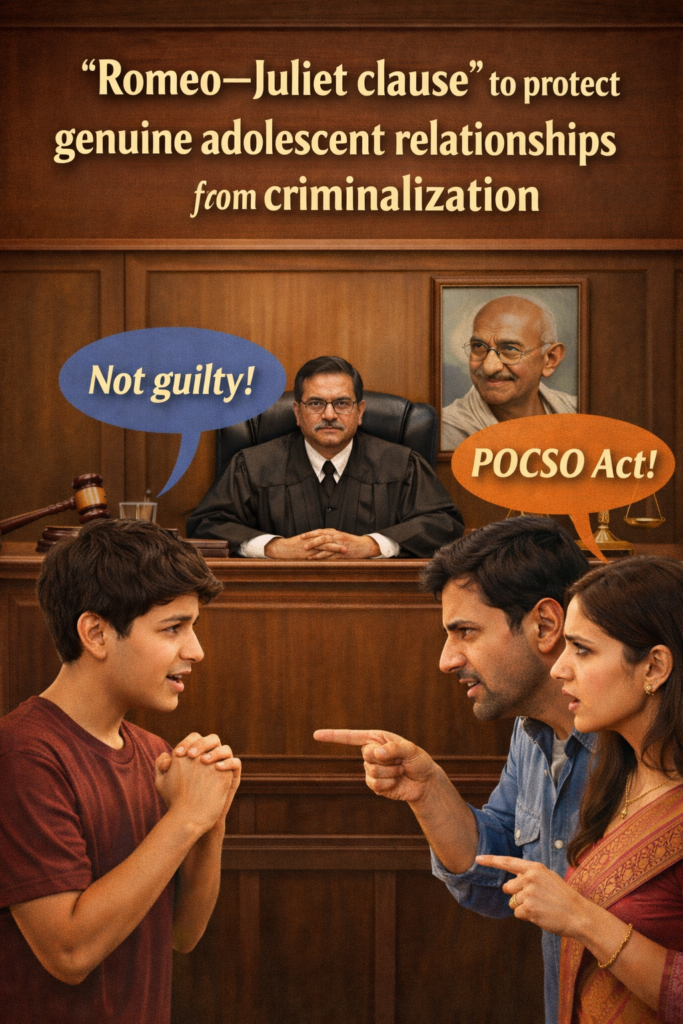
- However, the remedy does not lie in judicial directives that bypass statutory procedure. The Court suggested legislative intervention, such as a “Romeo–Juliet clause” to protect genuine adolescent relationships from criminalization.
Final Order
- The appeal was allowed. The directions issued by the High Court were set aside.
- The bail granted to the respondents was left undisturbed, but the legal reasoning of the High Court was overruled.
- The judgment is prospective and does not affect cases where bail was already granted following the impugned directions.
- A copy of the judgment was directed to be sent to the Secretary, Law Ministry, Government of India, for consideration of legislative measures to prevent misuse of the POCSO Act.
Significance
The judgment reinforces the statutory hierarchy for age determination under the JJ Act and curbs judicial overreach in bail proceedings. It underscores that while courts may note systemic misuse of protective laws like POCSO, they cannot devise procedural mandates that contradict legislative intent. The ruling also opens the door for potential legislative reform to balance child protection with justice in adolescent relationship cases.
For the complete judgment click here

Advocate Kiran S R – A highly skilled, passionate, dedicated advocate, with vast wealth of knowledge, professionalism, ethical approach and expert skills. One of the sharpest legal mindset brings the best principles of legal practice to the forefront. A qualified Engineer turned Advocate. His passion, dedication and vision to help and assist his clients achieve the best results is his driving force.
